Towing capacity explained: tow rating vs GCWR vs payload
Short answer: your real towing capacity is the smallest of four ratings after your actual load is applied. Run the towing capacity check with your door-sticker numbers to see which one is binding.
The four ratings
| Rating | What it caps | Where to find it |
|---|---|---|
| Tow rating | Maximum trailer weight the drivetrain is rated to pull (with WDH on most numbers you see) | Owner's manual / towing guide for YOUR configuration |
| GCWR | Loaded truck + loaded trailer, combined | Door-jamb sticker / towing guide |
| Payload rating | Everything on the truck: passengers, cargo, tongue weight, hitch hardware | Door-jamb sticker: GVWR − curb weight |
| Hitch class | Weight the receiver itself can carry. CURT lists Class 3 up to 8,000 lb gross and 800 lb tongue (12,000 lb and 1,200 lb with weight distribution) and Class 4 up to 10,000 lb and 1,000 lb tongue (12,000 lb and 1,200 lb with weight distribution). The stamp on a specific hitch can be lower. | Stamped on the hitch; class chart at CURT |
A worked example from a published towing guide
Ford's 2025 F-150 Towing Guide says horsepower, torque, payload, and towing are independent and may not be achieved simultaneously. The summary line for the 3.5L PowerBoost Full Hybrid lists a maximum tow of 11,200 lb, with a footnote that this uses Tow/Haul and the Max Tow Axle, and a maximum available payload of 1,815 lb. A payload footnote says maximum payload varies and to see the doorjamb. Do not treat 1,815 lb as the payload of one truck, and do not pair it with a different row's GCWR.
The same guide says not to exceed a trailer weight of 5,000 lb without a weight-distribution system, and that trailer tongue load should be 10 percent of total loaded trailer weight. Ten percent is the floor of the 10–15 percent band CURT publishes for conventional tongue weight. A footnote describes those maximum towing capabilities as properly equipped vehicles with required equipment and "a 150-lb. driver and passenger." Combined weight cannot exceed the listed GCWR. Tongue weight plus passengers plus cargo cannot exceed rear GAWR or GVWR on the Safety Compliance Certification Label. Ford says the ratings were calculated with SAE J2807. This page does not copy that standard's tables.
Tongue-weight inputs: loaded trailer 5,000 lb, measured percentage 10. TTC.tongueWeight returns 500 lb, inside the 10–15 percent band, with targets of 500, 600, and 750 lb.
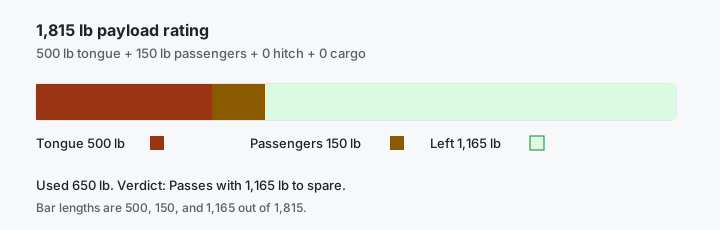
Payload inputs: payload rating 1,815 lb (the published PowerBoost maximum available payload, not a door sticker), tongue 500 lb, hitch hardware 0 lb because no hitch weight is published for this example, passengers 150 lb, cargo 0 lb. TTC.payloadCheck returns 650 lb used and 1,165 lb left, and the verdict "Passes with 1,165 lb to spare."
CURT Class 3 weight-carrying is up to 8,000 lb gross and 800 lb of tongue, so 500 lb of tongue fits that column. The factory hitch-receiver chart in the Ford guide lists F-150 weight-carrying at a maximum trailer weight of 5,000 lb and a maximum tongue of 500 lb, and weight-distributing at 13,500 lb of trailer and 1,350 lb of tongue. The guide says receiver capacities may exceed the vehicle's maximum loaded trailer weight.
A common mistake
Reading only the maximum tow rating. On the PowerBoost summary, 11,200 lb of tow and 1,815 lb of payload are separate maxima. The guide says they may not be available at the same time. The binding check is the door sticker plus the loaded trailer.
GCWR still has to pass
Payload can pass and GCWR can still fail, because GCWR caps the loaded truck and the loaded trailer together. NHTSA's brochure says to look up GVWR, maximum trailer weight (it varies by transmission and four-wheel drive), GCWR, and GAWR. Ford's notes say combined weight cannot exceed the listed GCWR. If the door sticker is missing, do not invent a curb weight by subtracting a tow rating from GCWR. The section below runs the towing tab on stated inputs and names the governing limit. Leftover payload pounds are not extra trailer pounds until they are divided by the towing tab's 12 percent tongue figure.
What going over actually does
NHTSA says too much tongue weight unloads the front wheels and makes steering less responsive, and that a weight-distribution hitch transfers weight to the front axle. CURT's adjustable-hitch guide says an adjustable hitch does not itself alter the vehicle's towing capacity. Check the rig with the capacity check using the sticker on that truck.
Limits
The NHTSA brochure is not a substitute for the owner's manuals. Ford's 1,815 lb payload and 11,200 lb tow rating are summary maxima for one engine family. If you cannot find the door sticker, get the label rather than substituting a brochure row.
2026 trucks in our chart with 10,000 lb+ published max conventional towing, and their published max payload
CURT lists Class 4 at up to 10,000 lb gross and 1,000 lb of tongue in the hitch-class table on this page. The rows below are copied from the 2026 truck towing capacity chart, and only the rows whose published max conventional towing is at least that 10,000 lb figure. Payload cells stay as published, including "not listed". Nothing in this table is estimated.
| Manufacturer | Model | Year | Configuration | Max conventional towing (lb) | Max payload (lb) | Source |
|---|---|---|---|---|---|---|
| Ford | F-150 | 2026 | 3.5L EcoBoost V6. Available maximum by engine. Requires Tow/Haul Package and Max Tow Axle upgrade (not shown). Horsepower, torque, payload, and towing may not be achieved simultaneously. | 13,500 | 2,440 | 2026 Ford F-150 Towing Information, revised 03-10-26 |
| Ford | F-150 | 2026 | 3.5L PowerBoost Full Hybrid V6. Available maximum by engine. Requires Tow/Haul Package and Max Tow Axle upgrade (not shown). Horsepower, torque, payload, and towing may not be achieved simultaneously. | 12,400 | 1,740 | 2026 Ford F-150 Towing Information, revised 03-10-26 |
| Ford | F-150 | 2026 | 5.0L Ti-VCT V8. Available maximum by engine. Towing requires Tow/Haul Package and Max Tow Axle upgrade (not shown). The payload cell in the guide is 2,235 lb. Footnote 6 states: Max payload of 2,225 lbs. on SuperCrew 4x2 with 5.0L gas engine and Tow/Haul Package and Max Tow Axle upgrade (not shown). | 12,800 | 2,235 | 2026 Ford F-150 Towing Information, revised 03-10-26 |
| Ram | 1500 | 2026 | 5.7L HEMI V8 with eTorque. Powertrain summary states 11,320 lb max towing and 1,650 lb max payload and does not name the cab in that sentence. The towing chart lists 11,320 lb for Crew Cab 5 ft 7 in bed 4x2, axle ratio 3.92, GCWR 17,000 lb. The payload chart lists 1,650 lb for Crew Cab 5 ft 7 in bed 4x2 at GVWR 6,900 lb. The chart says the ratings are mutually exclusive. | 11,320 | 1,650 | 2026 Ram 1500 Payload & Towing, 26MY_Ram_1500_PayTow_2.3 |
| Ram | 1500 | 2026 | 3.0L I6 Twin Turbo Hurricane (standard output). Powertrain summary states 11,610 lb max towing and 1,930 lb max payload. The towing chart lists 11,610 lb for Quad Cab 6 ft 4 in bed 4x2, axle ratio 3.92, GCWR 17,000 lb (the 4x4 cell on that row is 11,370 lb). The payload chart lists 1,930 lb for Quad Cab 6 ft 4 in bed 4x2 at GVWR 6,900 lb (the 4x4 cell is 1,910 lb). The chart says the ratings are mutually exclusive. | 11,610 | 1,930 | 2026 Ram 1500 Payload & Towing, 26MY_Ram_1500_PayTow_2.3 |
| Ram | 1500 | 2026 | 3.0L I6 Twin Turbo Hurricane H/O. Powertrain summary states 10,000 lb max towing and 1,490 lb max payload. The towing chart marks 10,000 lb as Limited. The payload chart marks 1,490 lb as RHO. The chart says the ratings are mutually exclusive, so these two figures are not one configuration. | 10,000 | 1,490 | 2026 Ram 1500 Payload & Towing, 26MY_Ram_1500_PayTow_2.3 |
| Chevrolet | Silverado 1500 | 2026 | 5.3L V8. Double Cab, standard bed, 2WD. GCWR 16,800 lb. Requires available Max Trailering Package. | 11,400 | not listed | 2026 Silverado 1500 Max Trailering chart |
| Chevrolet | Silverado 1500 | 2026 | 6.2L V8. Crew Cab, short bed, 4x4. GCWR 19,100 lb. Footnote: RST with available Max Trailering Package and 20-inch wheels. | 13,200 | not listed | 2026 Silverado 1500 Max Trailering chart |
| Chevrolet | Silverado 1500 | 2026 | 6.2L V8. Crew Cab, standard bed, 4x4. GCWR 19,100 lb. Footnote: RST with available Max Trailering Package and 20-inch wheels. | 13,200 | not listed | 2026 Silverado 1500 Max Trailering chart |
| Chevrolet | Silverado 1500 | 2026 | Duramax 3.0L I-6. Double Cab, standard bed, 2WD. GCWR 19,100 lb. Requires available Max Trailering Package and 20-inch wheels. | 13,300 | not listed | 2026 Silverado 1500 Max Trailering chart |
| GMC | Sierra 1500 | 2026 | 5.3L V8. Crew Cab, short bed, 2WD. GCWR 16,800 lb. Requires available Max Trailering Package. | 11,200 | not listed | 2026 GMC Sierra 1500 Trailering Charts |
| GMC | Sierra 1500 | 2026 | 5.3L V8. Double Cab, standard bed, 2WD. GCWR 16,800 lb. Requires available Max Trailering Package. | 11,200 | not listed | 2026 GMC Sierra 1500 Trailering Charts |
| GMC | Sierra 1500 | 2026 | 6.2L V8. Crew Cab, short bed, 4WD. GCWR 19,100 lb. Requires available Max Trailering Package and 20-inch wheels. | 13,100 | not listed | 2026 GMC Sierra 1500 Trailering Charts |
| GMC | Sierra 1500 | 2026 | Duramax 3.0L Turbo-Diesel. Double Cab, standard bed, 2WD. GCWR 19,000 lb. Requires available Max Trailering Package and 20-inch wheels. | 13,300 | not listed | 2026 GMC Sierra 1500 Trailering Charts |
| Toyota | Tundra | 2026 | Available maximum stated as up to 12,000 lb. The brochure does not name the cab, bed, or drivetrain for that figure. Footnote 2: Never tow beyond a vehicle's published towing capacities. | 12,000 | not listed | 2026 Toyota Tundra eBrochure |
| Toyota | Tundra | 2026 | Limited CrewMax. Footnote 6: Towing capacity shown is 11,350 lbs. Limited CrewMax shown in Magnetic Gray Metallic. The footnote does not name bed length or drivetrain. | 11,350 | not listed | 2026 Toyota Tundra eBrochure |
Which limit governs on a stated pass
Stated inputs, not a door sticker: tow rating 13,500 lb and payload rating 2,440 lb are the available maxima on Ford's revised 03-10-26 F-150 sheet for the 3.5L EcoBoost, in the table above. Ford says horsepower, torque, payload, and towing may not be achieved simultaneously. GCWR 20,000 lb, curb weight 5,000 lb, cargo 0 lb, and passengers 150 lb are stated inputs for this pass, not figures from that sheet. No hitch rating is entered. Loaded trailer 5,000 lb. The towing tab uses 12 percent tongue weight, the midpoint of CURT's 10–15 percent band on the tongue weight guide, not a separate standard.
Tongue weight is 5,000 × 0.12 = 600 lb. The loaded truck without the trailer is 5,000 + 0 + 150 = 5,150 lb, so the GCWR cap is 20,000 − 5,150 = 14,850 lb. Payload left for tongue weight is 2,440 − 150 − 0 = 2,290 lb, and 2,290 / 0.12 = 19,083.333…, which the towing tab rounds to a 19,083 lb trailer cap. The tow rating cap is 13,500 lb. The lowest cap is the tow rating.
TTC.towCheck for those inputs returns a max safe trailer of 13,500 lb, limited by tow rating. With the 5,000 lb trailer entered, the load is inside every cap: tow margin 8,500 lb, GCWR margin 9,850 lb, and payload margin 1,690 lb. The 13,500 lb and 2,440 lb figures are available maxima, not one truck and not a door sticker.
Open that pass in the towing tab. The full chart is the 2026 truck towing capacity chart.
As an Amazon Associate I earn from qualifying purchases. The Amazon links below are affiliate links; they don't change the math.
If payload is your binding limit, hardware can't fix it — but the right weight-distribution hitch with sway control makes a legal load dramatically safer. WDH with sway control on Amazon
Related tools
Towing capacity check
All four margins computed from your real numbers.
Tongue weight guide
The 10–15% rule and how to measure it on a packed trailer.
What size hitch for a 15,000 lb trailer
Receiver class when the trailer is heavier than a half-ton example.
How to choose a trailer
Loaded weight first, then the hitch column that weight actually fits.
Fifth-wheel hitches
Why a conventional maximum and a fifth-wheel maximum can differ at the same GCWR.
Towing a new travel trailer
The first trip, after the four ratings are known.
How to weigh a truck and trailer
Axle weights on a CAT Scale, compared with the door-sticker ratings.
FAQ
What is the difference between tow rating, GCWR, and payload?
Tow rating is the maximum trailer weight in the manufacturer's guide. GCWR caps the loaded truck and the loaded trailer together. Payload caps what the truck carries, including tongue weight. NHTSA says to look up all of them. The lowest one after the load is applied is the limit that binds.
Does a weight-distribution hitch increase towing capacity?
No. Ford's F-150 notes require a weight-distribution system above a 5,000 lb trailer, and a weight-distribution hitch transfers weight to the front axle. CURT says an adjustable hitch does not itself alter the vehicle's towing capacity. Payload, tow rating, and GCWR do not increase because the hitch did.
What does this calculator return for a 5,000 lb trailer at 10 percent?
Tongue weight is 500 lb, inside the band, with targets of 500, 600, and 750 lb. Against Ford's published 1,815 lb PowerBoost maximum available payload, with 150 lb of passengers and no extra hitch or cargo weight, payload used is 650 lb and 1,165 lb remains.
Compiled with AI assistance from the sources below. Spot an error? Email jpanasuk@gmail.com.
Sources
Sources for the ratings and rules cited on this page:
- Ford, "2025 Ford F-150 Towing Guide." https://www.ford.com/content/dam/brand_ford/en_us/brand/towing/pdf/2025-Ford-F150-Towing-Guide-1.pdf
- SAE J2807, cited by Ford as the method for the ratings. The standard's tables are not copied here. https://saemobilus.sae.org/standards/j2807_202411-performance-requirements-determining-tow-vehicle-gross-combination-weight-rating-trailer-weight-rating
- NHTSA, "Towing a Trailer: Being Equipped for Safety." https://dmna.ny.gov/nynm/training/NHTSA_TowingSafety.pdf
- CURT Manufacturing, "Types of Trailer Hitches and Hitch Classes." https://www.curtmfg.com/types-trailer-hitches
- CURT, "The Complete Buyer's Guide for Adjustable Trailer Hitches." https://www.curtmfg.com/curt-adjustable-trailer-hitch-buyers-guide