Home · Topics · How to weigh a truck and trailer
How to Weigh a Truck and Trailer at a CAT Scale
Built by Jeremy Panasuk · Published October 6, 2026
A scale ticket is axle weight and a total. It is not tongue weight, and it is not the payload check. Those are two other measurements.
Where each axle sits
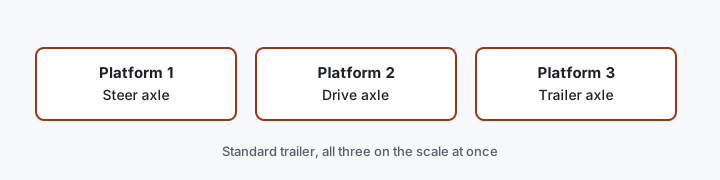
CAT Scale's how-to-weigh page is the instruction. For a standard trailer, drive on so the steer axle is on platform 1, the drive axle is on platform 2, and the trailer axle is on platform 3. All three are on the scale at once.
A spread-axle trailer starts in that same first position. The weighmaster then asks you to pull forward. In the second position the front trailer axle is on platform 2 and the rear trailer axle is on platform 3. An oversize weigh also requires you to move the truck during the weighing. CAT says to use the spread-axle instructions for an oversize weigh, and to call the 24-hour help desk at 1-877-228-7225, extension 6, if you are weighing multiple axles. This page does not redraw that second position as if it were a pickup and one bumper-pull trailer.
For a truck and trailer, the combination must be completely on the scale. CAT says it is best to put the steer axle on platform 1 and the drive axle on platform 2. The trailer will normally show up on platform 3. A truck and fifth wheel uses the same layout: steer on platform 1, drive on platform 2, trailer normally on platform 3. A truck and boat is the same, with the boat trailer normally on platform 3.
CAT says the scales can give axle weights and a total gross weight. They cannot weigh each corner of the vehicle, and they cannot provide individual wheel weights. CAT does not allow that kind of weighing, because it can damage the vehicle and the scale.
The 2,000 lb threshold
CAT says its scales are set to a weight threshold of 2,000 lb. If the vehicle or combination is estimated to be lighter than 2,000 lb, call the 24-hour help desk before you pull on: 1-877-CAT-SCALE (228-7225), extension 6. Tickets cannot be altered after they are printed. This page does not state a price for a weigh.
What to compare the ticket to
NHTSA's towing brochure says to look up the tow vehicle's GVWR, its maximum trailer weight (that figure varies by transmission and four-wheel drive), GCWR, and GAWR. The axle weights on the ticket are what you compare with the GAWR figures on the door sticker. The total of truck and trailer is what you compare with GCWR. Ford's 2025 F-150 notes say combined weight cannot exceed the listed GCWR, and that you should not exceed the maximum loaded trailer weight. A brochure row is not a substitute for the sticker on the truck you drove onto the scale.
This ticket is not tongue weight
CURT's vehicle-scale method for tongue weight is two passes: weigh the tow vehicle with no trailer, then weigh it again hitched, with the trailer wheels off the scale. The difference is tongue weight. A CAT visit that leaves the trailer on platform 3 weighs the trailer axles. It does not perform that subtraction. The distances and the bathroom-scale layouts are on the tongue weight guide.
A payload check, labeled as not a ticket
The numbers below are not a scale reading. They are this site's payload function, using figures Ford published, so you can see the calculator beside the idea of a weigh. Ford's 2025 F-150 guide says horsepower, torque, payload, and towing may not be achieved simultaneously. The 3.5L PowerBoost summary lists a maximum available payload of 1,815 lb and says maximum payload varies by doorjamb. Do not mix that 1,815 lb with a GCWR from a different row, and do not treat it as your sticker.
The same guide says tongue load on a conventional hitch should be 10 percent of loaded trailer weight, and not to exceed 5,000 lb of trailer without a weight-distribution system. Ten percent is the floor of CURT's 10–15 percent band. A footnote on the maximum towing capabilities says "a 150-lb. driver and passenger."
Tongue-weight inputs, not a scale: trailer 5,000 lb, measured percentage 10. TTC.tongueWeight returns 500 lb, inside the band, targets 500, 600, and 750 lb.
Payload inputs, not a scale: payload rating 1,815 lb, tongue 500 lb, hitch hardware 0 lb because no hitch weight is published here, passengers 150 lb, cargo 0 lb. TTC.payloadCheck returns 650 lb used, 1,165 lb left, and "Passes with 1,165 lb to spare."
When you have a real ticket, enter the tongue weight you measured with CURT's two-pass method, the payload from your door sticker, and the hitch weight you weighed. Do not type these Ford summary numbers in place of the sticker.
A common mistake
Subtracting the trailer's platform from the total and calling the rest tongue weight. The trailer platform is the weight on the trailer axles. Tongue weight is the difference between the tow vehicle alone and the tow vehicle hitched with the trailer wheels off the scale. Mixing those two procedures double-counts or drops the tongue.
Limits
CAT's page is the procedure for CAT scales. Another scale company can number its platforms differently. The NHTSA brochure is not a substitute for the owner's manuals. If the combination is under the 2,000 lb threshold, or the trailer is spread-axle or oversize, call the help desk rather than guessing a second pull. If an axle on the ticket is over the GAWR on the door sticker, the trip waits until the load changes.
Related
FAQ
Which CAT Scale platform is the trailer on?
For a standard trailer, platform 3. Steer is platform 1 and drive is platform 2. A truck and trailer, and a truck and fifth wheel, use that same layout, and the trailer normally shows up on platform 3.
Does one CAT Scale ticket equal tongue weight?
No. Tongue weight, in CURT's vehicle-scale method, is the tow vehicle weighed alone, then weighed hitched with the trailer wheels off the scale. The ticket with the trailer on platform 3 is axle weight.
What if the combination is under 2,000 lb?
CAT says the scales are set to a 2,000 lb threshold. Call 1-877-CAT-SCALE (228-7225), extension 6, before you weigh a lighter combination. The scales also cannot weigh corners or individual wheels.
Compiled with AI assistance from the sources below. Spot an error? Email jpanasuk@gmail.com.
Sources
- CAT Scale, "How To Weigh." https://catscale.com/how-to-weigh/. Accessed October 6, 2026.
- CURT, "How to Measure Tongue Weight." https://www.curtmfg.com/trailer-parts/couplers/learn-more. Accessed October 6, 2026.
- NHTSA, "Towing a Trailer: Being Equipped for Safety." https://dmna.ny.gov/nynm/training/NHTSA_TowingSafety.pdf. Accessed October 6, 2026.
- Ford, "2025 Ford F-150 Towing Guide." https://www.ford.com/content/dam/brand_ford/en_us/brand/towing/pdf/2025-Ford-F150-Towing-Guide-1.pdf. Accessed October 6, 2026.
- SAE J2807, cited by Ford as the method for the ratings. Tables are not copied here. https://saemobilus.sae.org/standards/j2807_202411-performance-requirements-determining-tow-vehicle-gross-combination-weight-rating-trailer-weight-rating. Accessed October 6, 2026.