Tongue weight: the 10–15% rule and how to actually measure it
Tongue weight is the single most-fiddled-with number in towing. Check yours with the tongue weight calculator, then use this to move it into the band.
Why the band is 10–15 percent
CURT says tongue weight is about 10 to 15 percent of gross trailer weight. Too little, under 10 percent, may let the trailer sway. Too much, over 15 percent, makes the vehicle less responsive when turning and braking. NHTSA says too little tongue weight causes sway, and too much unloads the front wheels. Sway is more likely as speed increases. This page does not name a speed at which sway becomes unrecoverable.
This site's tongue-weight function treats under 10 percent as too light and over 15 percent as too heavy. Twelve percent is the calculator's midpoint of CURT's band. It is not a separate standard.
How CURT says to measure it
CURT's tongue-weight page describes three layouts. This page does not add a price or an accuracy percentage to any of them.
Under 300 pounds, scale under the jack
If tongue weight is under 300 lb, CURT says a bathroom scale can take the load directly. Put a piece of plywood on the scale so the jack does not damage it. The trailer should be on level ground with the wheels chocked, and the coupler at towing height so the trailer is level.
Over 300 pounds, the lever
CURT's lever uses a 2x4 at least 3-1/2 feet long, a scale, a block, and pipes. On level ground with the wheels chocked, put the scale about 2 feet from the tongue and the block about 1 foot from the tongue, on opposite sides of the tongue, so the scale reads one third. A vertical pipe under the tongue holds the coupler. Multiply the scale reading by 3. The older description that put the coupler 24 inches from the fulcrum and the scale 12 inches from it is not this layout. This page does not invent a scale reading. The factor of 3 is CURT's multiplier for that geometry.
- Park on level ground and chock the trailer wheels.
- Use a 2x4 at least 3-1/2 feet long. Set the block about 1 foot from the tongue and the scale about 2 feet from the tongue, on opposite sides.
- Set a vertical pipe under the tongue so the coupler is supported, and read the scale.
- Multiply that reading by 3. That product is the tongue weight this layout is built to estimate.
Vehicle scale, two passes
CURT's vehicle-scale method weighs the tow vehicle with no trailer, then weighs it again hitched, with the trailer wheels off the scale. The difference is tongue weight. One pass that leaves the trailer axles on their own platform is a different measurement. That layout is on how to weigh a truck and trailer. It is not a tongue-weight reading.
Worked example in the calculator
Inputs: trailer weight 5,000 lb, measured percentage 10. TTC.tongueWeight returns 500 lb, percentage 10, inside the 10–15 percent band, with targets of 500, 600, and 750 lb. Ten percent is the bottom of CURT's band and the tongue load in Ford's conventional F-150 note. When you have a scale reading, enter that measured tongue weight. Do not type 10 only because it is the floor of the band.
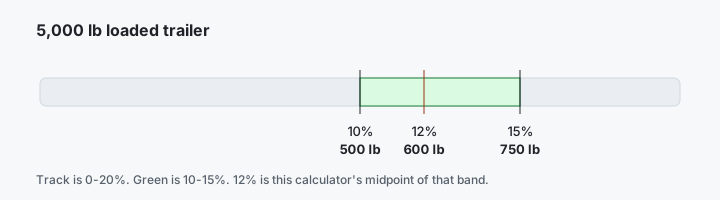
TTC.tongueWeight returns for a 5,000 lb trailer: 500 lb at 10 percent, 600 lb at 12 percent, and 750 lb at 15 percent. The 10–15 percent band is CURT's. Twelve percent is this calculator's midpoint of that band, not a separate standard.Moving the number
- Under 10 percent: shift cargo toward the front of the trailer, ahead of the axles, then measure again.
- Over 15 percent: shift cargo behind the axles, then measure again.
NHTSA says a weight-distribution hitch transfers weight to the front axle. This page does not claim that transfer leaves the measured tongue-weight percentage unchanged. If the percentage is outside the band, move cargo on a trailer packed the way you will tow it, then measure again. What the calculator returns one point under the floor is on trailer sway.
As an Amazon Associate I earn from qualifying purchases. The Amazon links below are affiliate links; they don't change the math.
A tongue-weight scale is the direct tool when the tongue is over the 300 lb bathroom-scale case CURT describes. tongue scales on Amazon · adjustable ball mounts on Amazon
Related tools
Tongue weight calculator
Enter trailer weight + measurement, get the verdict and your target band in pounds.
Towing capacity explained
How tongue weight feeds the payload limit that actually binds.
What size hitch for a 3,500 lb trailer
Hitch class for a trailer at this loaded weight.
How to grease trailer wheel bearings
The axle load that remains after tongue weight comes off the coupler.
Towing a new travel trailer
First-trip checks, and a payload example at 10 percent tongue weight.
How to weigh a truck and trailer
Platform order at a CAT Scale. Not a substitute for the two-pass tongue method above.
FAQ
What percentage of trailer weight should be on the tongue?
CURT's range is about 10 to 15 percent of gross trailer weight. Under 10 percent may sway. Over 15 percent makes the tow vehicle less responsive. This calculator's midpoint of that band is 12 percent.
How do I measure tongue weight with a bathroom scale?
Under 300 lb, CURT says the scale can sit under the coupler, with plywood to protect the scale. Over 300 lb, use the lever: block about 1 foot from the tongue, scale about 2 feet from the tongue on the opposite side, and multiply the scale reading by 3.
Does one CAT Scale pass equal tongue weight?
No. CURT's vehicle-scale method weighs the tow vehicle alone, then hitched with the trailer wheels off the scale, and subtracts. A CAT ticket with the trailer on its own platform is axle weight. That visit is on the weighing page.
Compiled with AI assistance from the sources below. Spot an error? Email jpanasuk@gmail.com.
Sources
Sources for the ratings and rules cited on this page:
- CURT, "How to Measure Tongue Weight." https://www.curtmfg.com/trailer-parts/couplers/learn-more
- NHTSA, "Towing a Trailer: Being Equipped for Safety." https://dmna.ny.gov/nynm/training/NHTSA_TowingSafety.pdf
- Ford, "2025 Ford F-150 Towing Guide," conventional tongue-load note of 10 percent. https://www.ford.com/content/dam/brand_ford/en_us/brand/towing/pdf/2025-Ford-F150-Towing-Guide-1.pdf